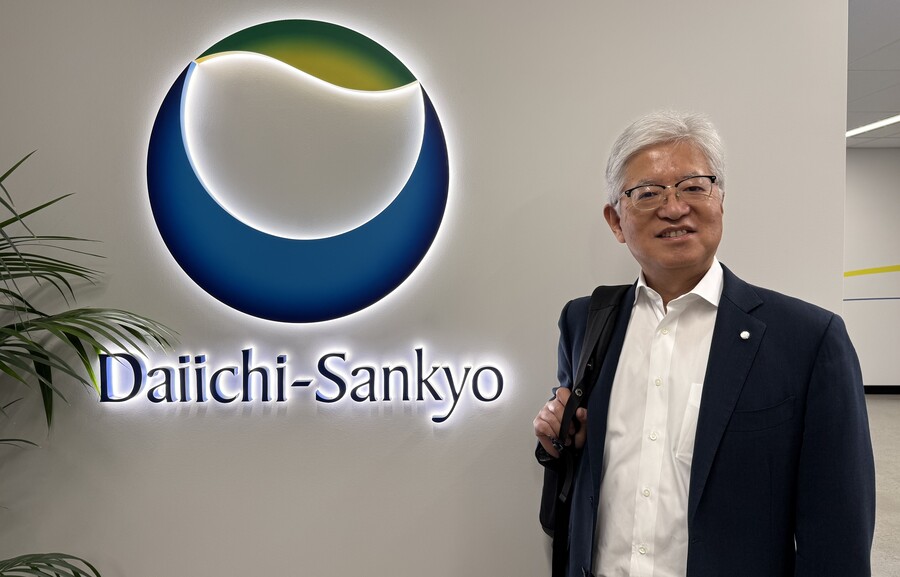
Daiichi Sankyo president and CEO Hiroyuki Okuzawa says the company is entering one of the most consequential phases in its 120-year history, as it prepares a new five-year plan built around global expansion, powerful technology platforms and an increasingly complex geopolitical environment.
Speaking during a wide-ranging interview with BioPharmaDispatch, Okuzawa reflected on the company’s “very, very successful” current five-year strategy, which concludes at the end of Daiichi Sankyo’s financial year in March 2026, and outlined a vision for 2030 and beyond.
Over the past five years, Daiichi Sankyo has almost doubled its global revenue and tripled profit, growth driven overwhelmingly by its DXd antibody–drug conjugate (ADC) technology, now one of the world’s most successful oncology platforms.
With five DXd-based medicines already in development, including two partnered with AstraZeneca and three with MSD, Okuzawa said the company is accelerating both late-stage clinical development and global commercial scale.
He believes the foundation is now in place for Daiichi Sankyo to achieve its aspiration of becoming a top-10 global oncology company by 2030, supported by more than 30 indications and hundreds of thousands of patients treated worldwide.
“We foresee further growth mainly in oncology,” he said, noting strong momentum in both clinical development and commercial capability. The next five-year plan will focus on strengthening the pipeline to support sustainable growth “beyond 2030,” driven by new modalities emerging from the company’s Tokyo discovery centre.
Beyond ADCs and Preparing the Next Technology Wave
While the DXd platform has become the company’s global signature, Okuzawa emphasised that Daiichi Sankyo will not be defined solely as an oncology specialist. Within the next five years, he expects the discovery organisation to present new “breakthrough-generating technologies” that could extend the company into non-oncology areas after 2030.
This approach, choosing a long-term scientific mission over a narrow therapeutic identity, reflects a view of innovation that deeply resonates across the company’s leadership.
AI Becomes a Core Strategic Engine
Okuzawa also revealed the extent to which artificial intelligence has become embedded in Daiichi Sankyo’s strategic and operational model.
“I am working with AI every day,” he said, describing an internal AI platform built by the company’s digital transformation team that he calls a “robust” enterprise-wide system. AI is now being deployed across drug discovery, clinical development, manufacturing, corporate functions and productivity initiatives.
The company recently opened an AI-enabled, robotics-driven research institute in San Diego, an experimental “smart laboratory” intended to transform how new molecules are discovered. A version of this model will be transplanted into Tokyo within two years, creating a globally connected research environment where scientists work across sites on an integrated AI discovery platform.
Okuzawa described an emerging future in which employees collaborate with internal “AI agents” embedded across the organisation, rapidly automating routine work, improving analysis and dramatically enhancing productivity.
Navigating a New Global Trade and Pricing Environment
Asked about the dramatically shifting international pharmaceutical environment, particularly the US Administration’s push for ‘Most-Favored-Nation' pharmaceutical pricing and new tariffs, Okuzawa acknowledged the profound uncertainty companies now face.
Since becoming CEO earlier this year, he said, trade and pricing developments have changed “every day, every week, every month,” making it impossible to issue definitive forward guidance on financial impacts. The new US–UK pharmaceutical pricing agreement, announced during Okuzawa’s Australia trip, added further unpredictability.
Despite this volatility, Okuzawa reiterated two principles that guide the company’s approach. They support open trade among major economies and a consistent belief in value-based pricing that reflects the real contribution of innovation.
He noted that Japan’s new Prime Minister has already designated pharmaceuticals and biotechnology as a national strategic investment priority. It is an encouraging signal, he said, for continued dialogue as the US shifts its trade posture.
Australia’s Role in the Global Network
Daiichi Sankyo’s decision to expand into Australia in recent years is already paying dividends, he said. The company now partners with more than 50 hospitals and research institutions and conducts over 20 oncology clinical trials locally. It has also designated a Melbourne institute as one of its global early-development centres, one of only about fifteen worldwide.
Okuzawa said Australia’s strong scientific workforce, reliable clinical trial environment, and high-quality medical systems make it a natural contributor to its global hub. The company intends to deepen its investment to bring future DXd-based therapies and new modalities to Australian patients.
On Australia’s famously complex health-technology assessment (HTA) system, Okuzawa was diplomatic but optimistic. While not claiming expertise, he said Daiichi Sankyo, working with its Alliance partner, AstraZeneca, has already secured reimbursement for two Enhertu indications and believes future submissions will be assessed fairly, taking international evaluations into account.
The Long Game: A Thousand-Mile View of Innovation
Throughout the conversation, Okuzawa repeatedly emphasised the ultra-long-term nature of pharmaceutical innovation. It has a long-term horizon that requires governments, investors, and societies to understand, value, and support scientific progress genuinely.
Daiichi Sankyo, he said, maintains its discovery-research investment regardless of fluctuations in annual profit because “creating pharmaceutical innovation takes a long, long time.”
The company’s mission, he believes, is to balance short-term patient access with the long-term sustainability of scientific discovery, ensuring that future patients benefit from breakthroughs made today.
This view is deeply connected to a Japanese commercial philosophy he referenced toward the end of the discussion. ‘Sanpo Yoshi’ means good for the seller, good for the buyer, good for society. It is a centuries-old ethic, and Okuzawa sees it as essential to the company’s future.
A Vision for 2030
As he celebrates his 40th year with Daiichi Sankyo and prepares to lead the company into its next strategic cycle, Okuzawa’s vision is clear.
Daiichi Sankyo is a top-10 global oncology company with a robust and diversified pipeline. A leader in AI-enabled drug discovery. A global organisation built on scientific excellence, strong people and deep international partnerships, and a company that continues to industrialise innovation in the Japanese tradition.
If those pillars hold, he believes, Daiichi Sankyo will enter 2030 with not only commercial strength but a vibrant future, one defined by the continuous delivery of life-changing medicines to patients around the world.